
By Gayathri Swahar
We’ve all seen it happen. Two founders, solving similar problems. Similar energy, similar vision. But one of them seems to be raking in all the support – funders, media, shoutouts, access. The other? Hustling twice as hard with half the visibility.
And no, the difference wasn’t their product. It wasn’t their pitch deck. And spoiler alert: it wasn’t even the size of their bank account or their privilege.
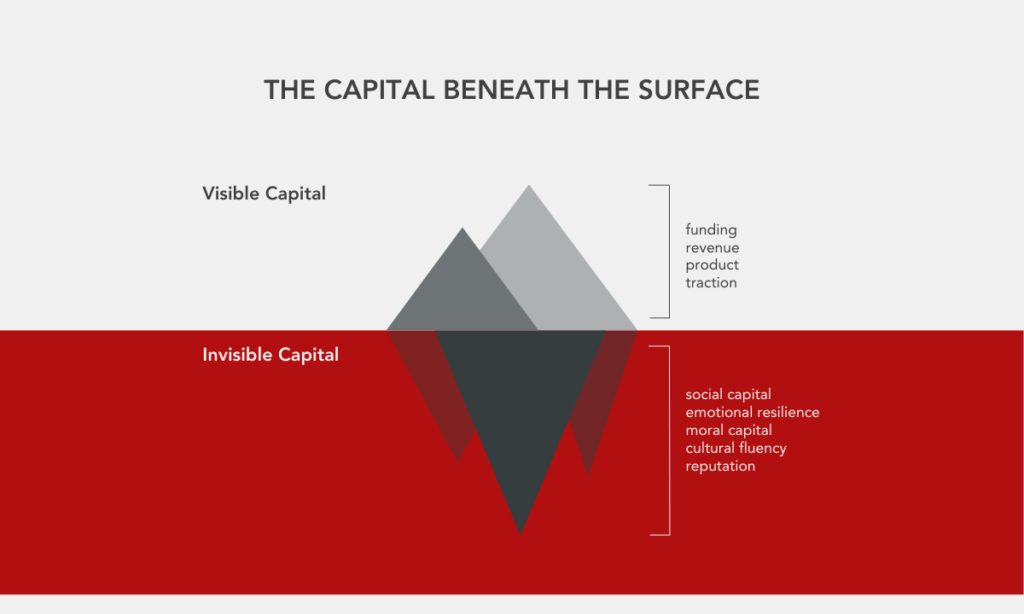
In fact, some of the most critical forms of capital in entrepreneurship often determine which founders will enroll more supporters than others. The difference isn’t just what they know or what they have. It’s the complete ecosystem of capital they’ve built, intentionally (or call in serendipity). That is to say some founders have mastered the art of compounding capital in ways money can’t buy.
They’ve built credibility by showing up for others. They’ve earned trust by adding value to communities. They’ve become known not just for what they create, but for how they show up.
These forms of capital often determine which entrepreneurs attract allies, and which are left hustling alone.
Building the capital ecosystem also means having a good understanding of what capital you have and what should be built. This simple Know-Be-Have-Show Framework will offer an easy approach to understanding the forms of capital that truly shape our access, power, and progress as entrepreneurs.
This framework breaks the capital ecosystem into four interconnected pillars of capital.
The Know-Be-Have-Show Framework:
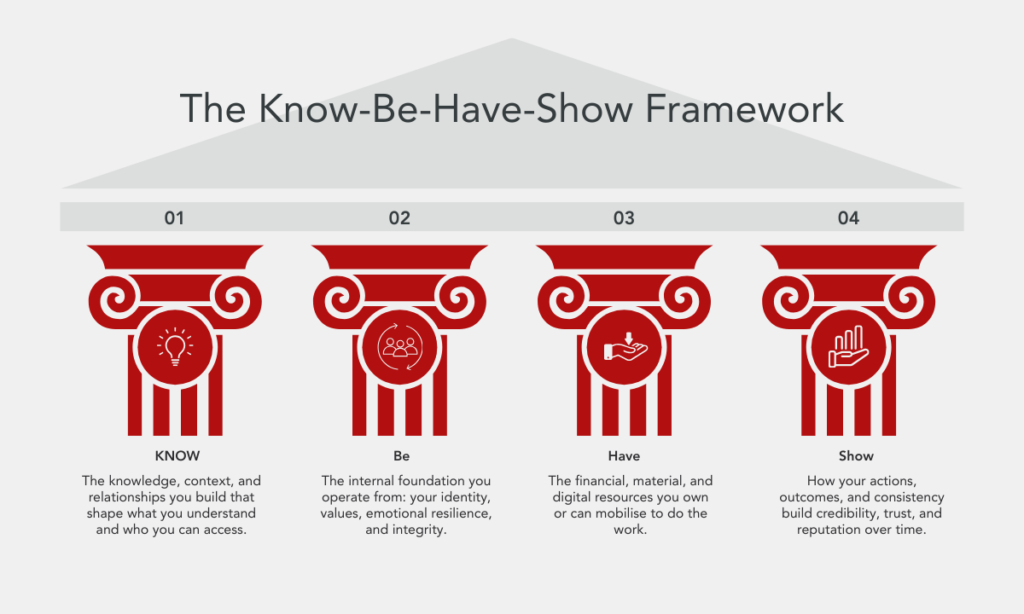
KNOW → What you know | How you know | Who you know
This is about human, cultural, and social capital
- What you know is basically your Human Capital: It is the cross-functional knowledge that makes you adaptable. The best founders don’t just know (things), they also know what they don’t know, which makes it easy for them to fill gaps making them coachable.
- How you know is your cultural capital: Your ability to read the room, decode unfamiliar environments, navigate with ease and adapt to the varying situations.
- Who you know is your Social Capital: The network of relationships that provide access to opportunities, knowledge, and resources.
BE → Who you are | How you show up
The ‘Be’ part of the capital is basically the internal foundation as an entrepreneur, which can be broken down into:
- Emotional Capital: Your self-awareness, regulation, resilience, and your ability to bounce back from setbacks.
- Identity Capital: How you own your story, build your narrative, and leverage your unique perspective
- Moral Capital: The integrity and values that build trust at scale. Investors and partners may forgive failures, but rarely a breach of values. Moral capital makes you investable in the long run.
HAVE → What you own | What you can access
This is basically the financial and digital capital
- Financial Capital: While money matters, financial capital is not about just money in hand or funding, but just much more on understanding finances and knowing how, where and when you should invest to develop growing or sustainable impact models.
- Digital Capital: Your ability to leverage technology, tools, and build meaningful digital presence
SHOW → What you create | How you demonstrate value
How the world perceives and experiences your impact:
- Reputation Capital: The trust and credibility you’ve built in your communities over time
- Opportunity Capital: Your track record of turning possibilities into results
- Alignment Capital: This is the age-old say-do ratio. The consistency between what you say and what you do, it demonstrates consistency between your values and your actions
Why this framework matters now
Most of the discussions about the capital ecosystem focus heavily on the “Have” pillar – raise money, build product, find market fit. Inherently, that approach misses three critical truths:
1. Each Capital compounds differently: money compounds through smart investments, social capital grows when you actually spend it, emotional capital deepens each time it’s tested, and moral capital strengthens through consistent action.
2. Access isn’t just about money. Founders struggle to get meetings despite having funding? They’re missing social and cultural capital. The entrepreneur with incredible ideas but no resilience? Burnout! Often lacking emotional capital to navigate setbacks.
3. Equity isn’t just ownership percentages. True equity is access to the full spectrum of resources—relationships, resilience, credibility, knowledge. Some entrepreneurs start with advantages across many capitals. Others must build them intentionally, brick by brick.
The multiplier effect
Here’s where it gets powerful. These capitals don’t work in silos, they interact and amplify each other.
And all there are interlinked and this is how entrepreneurs build their capital ecosystem
- Who you know (social capital) can amplify What you know (human capital)
- Your identity capital (who you are) shows up through your moral capital (what you stand for).
- Your financial capital (what you have) scales through digital capital (how you show up online).
- Your reputation capital grows when alignment ties all the other forms together.
Remember, it is a framework and not a formula
This isn’t about checking boxes or achieving some perfect balance across all capitals. Or have 100% in all the boxes. Every entrepreneur’s journey is different, for example some may start with strong social capital but need to build financial literacy while others have deep technical knowledge but struggle with cultural navigation etc.
The framework is a diagnostic tool. A way to:
- Audit where your current strengths and gaps are
- Strategise which capitals to build next based on your goals
- Recognise the invisible advantages and barriers in your entrepreneurial ecosystem
- Intentionally develop the forms of capital that will most accelerate your impact
Your starting point
Before you leave this page, pause, and try this reflection: Think about your last major entrepreneurial breakthrough- a partnership that clicked, funding that came through, a hire that transformed your team, a door that opened unexpectedly.
Now ask yourself:
- What types of capital made that breakthrough possible?
- Was it just financial capital, or were other forms at play?
- How might you intentionally build those same types of capital for future breakthroughs?
- What capital has been most crucial in your journey so far? And which one do you need to build next?
And if this resonated, drop in your comments and follow along.
Because your network isn’t just your net worth. Your network is your access, your credibility, and often, your competitive advantage.
The Know Framework: Building social capital that compounds
Social Capital = Who You Know + Who Knows You + Who Trusts You
Most entrepreneurs focus only on the first part, collecting connections. But real social capital lives at the intersection of relationships, reputation, and reciprocity.
And here’s something we often miss: building social capital isn’t about appearing interested in people, it’s about being interested in them. When you genuinely take time to know someone’s story, their aspirations, and even their struggles, you move beyond networking into relationship-building. That authenticity creates trust, and trust is the real currency of social capital.
1. Show up before you need something
The biggest mistake entrepreneurs make is treating networking like emergency fundraising. They show up when they’re desperate for customers, investors, or partnerships, pitch-ready and business cards in hand.
Flip the script. Instead of asking “Who can help me?” start with “Who can I help?”
Practical implementation:
- Spend 30 minutes weekly commenting thoughtfully on others’ LinkedIn posts
- Share opportunities you can’t pursue with founders who could benefit
- Celebrate others’ wins publicly before they celebrate yours
- Attend industry events not as a vendor, but as a contributor and active learner
Founders who build incredible social capital often become connectors themselves. They introduce investors to promising startups, link nonprofits with corporate partners, or share speaking opportunities they can’t take. This generosity creates a reputation that opens doors long before they need to knock.
2. Map your network strategically (Not just socially)
Most entrepreneurs network randomly; they meet people at events, connect on LinkedIn, and keep fingers crossed, hoping something sticks. Intentional founders, on the other hand, map their networks like strategy consultants map markets.
The social capital audit:
- Knowledge bridges: Who connects you to insights in your sector?
- Funding bridges: Who has relationships with investors aligned with your mission?
- Influence bridges: Who knows policymakers, industry leaders, or key decision-makers?
- Reciprocity check: Who are you a bridge for?
And don’t underestimate the power of “weak ties”. Research shows most opportunities come not from close friends, but from acquaintances, people in adjacent circles who see different opportunities than your inner circle does.
Your homework: Identify three relationship gaps in your network this week. Then spend time in communities where those connections naturally exist.
3. Practice being in “unfamiliar rooms”
Every industry has its own language, rituals, and unwritten rules. The faster you learn to navigate different environments, the faster you build credibility across sectors.
Why this matters: Social entrepreneurs often need to speak multiple languages — impact investor language, government partnership language, corporate CSR language, grassroots community language. Each requires different social capital.
Practical steps:
- Join policy roundtables even if policy isn’t your strength
- Attend investor forums before you’re actively raising
- Participate in conferences outside your sector
- Volunteer for boards or committees in adjacent industries
Yes, it’s uncomfortable. But that discomfort is social capital under construction.
The trust multiplier effect
Here’s what distinguishes successful social entrepreneurs: they build trust at scale.
They become known not just for what they’re building, but for how they build it. For their values in action when no one’s watching. For how they treat vendors, competitors, and critics alike.
This reputation becomes a force multiplier:
- Investors take meetings faster
- Partners say yes more quickly
- Talent wants to join their mission
- Media amplifies their story
- Customers become evangelists
The Network effect of values
The most powerful social capital is built when your relationships align with your values. When you’re not just connected to people, but connected to people who share your vision for change.
This is particularly crucial for social entrepreneurs. Your network becomes part of your impact strategy. The relationships you build become channels for the change you want to create.
Questions to ask yourself:
- Does my network reflect the diversity of communities I aim to serve?
- Am I building relationships across power structures, not just within my peer group?
- Are my connections helping me see blind spots in my approach?
- Am I genuinely curious about the people I meet, beyond what they can do for me?
- How am I using my growing platform to elevate voices that need amplifying?
Your social capital action plan
This week
- Audit your last five opportunities. How did each actually come to you? Through relationships or cold outreach?
- Map your current bridges: Who connects you to knowledge, funding, and influence?
- Identify three relationship gaps that could unlock new possibilities for your venture.
- Ask yourself after each new interaction: Did I show genuine curiosity about this person?
This Month
- Make three introductions between people in your network (with no expectation in return)
- Join at least one “unfamiliar room”, attend an event or community outside your usual circles
- Share one opportunity you can’t pursue with someone who could benefit
- Reach out to someone you admire simply to understand their journey
This Quarter
- Build a systematic relationship strategy tied to your business goals
- Establish your reputation in one new community relevant to your mission
- Create content or convenings that bring your network together around shared values
- Choose one relationship to invest in more deeply, with AUTHENTICITY at the center.
Build ecosystems, Not just companies
The entrepreneurs who truly scale impact don’t just build companies, they build ecosystems. They don’t just develop products or solutions, they develop movements.
And movements are built on relationships. On trust. On the social capital that turns individual efforts into collective change.
Your social capital is more than your professional network. It is your pathway to the resources, insights, and partnerships that can amplify your impact exponentially.
The question isn’t whether you need or have social capital. The question is: are you building it intentionally and authentically?